Relationship Building: How I Can Strengthen Class Community and Teacher-Student Respect in my Future Classroom
One of my top concerns regarding being a teacher is the fear of whether my students and I will mesh. I do not require my students to adore me; however, I must have their respect so that they will adequately observe and employ my lessons to their capacity. When a teacher maintains a healthy relationship with students, students “more readily accept the rules and procedures and the disciplinary actions that follow their violations” (Marzano et al., 2003, p. 41). My fears are not uncommon, which is why experts are determined to figure out the best ways to maintain a healthy and beneficial student-teacher relationship. Through the readings in class, I have found a set of rules and strategies that I feel accurately and comprehensively achieve the outcome I was searching for. To create a successfully well-managed class, instructors must consider their teacher-student relationship through their discourses, management styles, and attitudes.
When considering effective relationships between a faculty member and a pupil, it is essential to understand the two disciplines. In “Classroom management that works: Research-based strategies for every teacher” it is revealed how these discourses are used and what they are. The first discourse that helps establish a repertoire between students and teachers is dominance versus submission (Marzano et al., 2003). Much like anything, an abundance of either aspect can prove harmful. High dominance provides clear and insightful instructions and lends an observing eye which drives home a meaning for students and sets standards and expectations (behavioral and academic). High submission, however, does the opposite – keeping students alone and in the dark (Marzano et al., 2003). Considering the two parts of the first discipline, I want to keep my instruction at a healthy medium, leaning and relying on dominance more heavily. Marzano et al. (2003) agree with my plans as neither end of the first discipline’s spectrum is best for a functional teacher-student relationship. The second discipline is cooperation versus opposition. Previously, through reading Himmele & Himmele (2017), the idea of Total Participation Techniques was discussed. These techniques called for a high level of cooperation and engagement to succeed. Cooperation is equally vital in classroom relationships as it maintains participation and engagement. High cooperation is “a concern for the needs and opinions of others and a desire to function as a team member as opposed to an individual” (Marzano et al., 2003, p.43). This essentially means that extreme cooperation is when a person cannot function independently, desiring the input of others and needing it. Being unable to complete a task without others is not ideal, but neither is resistance towards a group’s shared goals or other people in general. Once again, I do not want my teaching style to fall into the extremes of cooperation or opposition in the second discipline. Marzano et al. (2003) write that “It is the right combination of moderate to high dominance (as opposed to extreme dominance) and moderate to high cooperation (as opposed to extreme cooperation) that provides the optimal teacher-student relationships for learning” (p. 43). Figuring out what works best for me as a teacher will be determined case-by-case, but I will be sure to keep these balances of discourses in mind.
All regards to practical and reasonable teaching involve balance. Management styles are no different, requiring experimentation and student insight (Milner et al., 2018). Marzano et al. (2003) overview three different variations of classroom management; the fourth would be more of a “no preference.” The first style is rules/rewards-punishments, which explains expectations while rewarding followers and punishing challengers. I find this style problematic because every student comes from a different background, so one set of standards may be more accessible for one student to follow than another (Milner et al., 2018). The following style is relationship-listening which focuses on student requests and wants rather than discipline (Marzano et al., 2003). While it is essential to keep students at the center of learning (Milner et al., 2018), entertaining unnecessary and unconstructive suggestions will not benefit my classroom. The final style is confronting-contracting, where a teacher directly calls out problematic behavior/disciplinary issues with room for change. This kind of management style allows a space for students to feel safe and is more likely not to trigger students with trauma (Venet, 2021). Understanding differences in students and letting go of rigid standards is the best way to instruct with acknowledgment of trauma while forming healthy boundaries with students. This kind of instruction is preferred by students (Marzano et al., 2003) and sets the grounds for higher morale.
Relying on students to be the keepers of their emotional intelligence and regulation is a hopeful and naïve expectation. Teachers sometimes cannot control their emotions, so asking students to do this without proper guidance and motivation is unfathomable. I never want to come off as unapproachable to my students, as I hope that they would come to be about questions with the curriculum as well as issues that might come up that potentially interfere with their learning experience. Researchers reported that “between 12 and 22 percent of all children in school suffer from mental, emotional, or behavioral disorders” (Marzano et al., 2003, p. 47), so providing a space that helps students to escape from these hardships is a vital factor in curating a functional teacher-student relationship. Teachers who come into their classes with optimism and enthusiasm are more likely to see the same energy reflected in them. After all, a school might be one of the only places that are somewhat trauma-free and acknowledge and help a child through their struggles (Marzano et al., 2003). The first step to helping others is putting forth the change and positivity I wish to see.
To create a successfully well-managed class, instructors must consider their teacher-student relationship through their discourses, management styles, and attitudes. My instructional style will be through high discipline and high cooperation as this is a happy medium that will achieve the best response from my students. Another way to appease students while maintaining control is through a confronting-contracting management style, which will set boundaries while allowing me the space to consider an incident fully. These set up schedules, routines, and limits, but what will especially bring my class together as a unit will be the unified positive outlook that I demonstrate and inspire within my students. I must be dedicated and unwavering in the effort and represent how I wish my students to succeed.
Artifact 1:
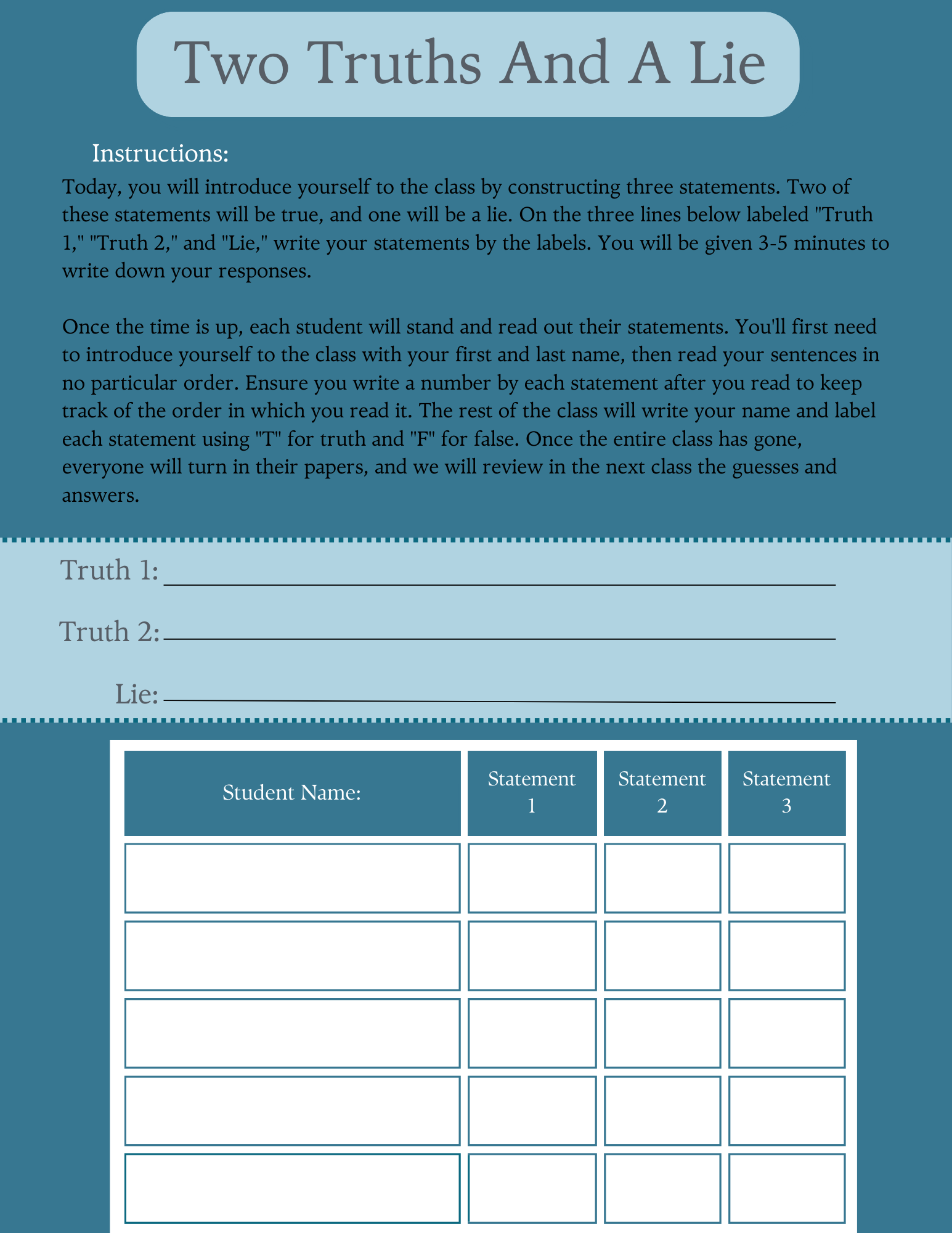
Artifact 1 is a “Two Truths and A Lie” worksheet/class activity for a high school class. This activity would most likely be completed within the first week of a new semester to foster a comfortable, friendly, and trustworthy environment. First, students will take a few minutes (3-5) to fill out their two true facts about themselves and one lie. After they have completed this part, each student will be instructed to stand, introduce themselves by their first and last name to the class, and read out each statement in no particular order. After reading the statements, the reader should jot down what order they read them (marking a 1, 2, or 3 by the statements). While students are presenting, the rest of the class should write the speaker’s name and place their guesses for each statement, writing a “T” for truth and an “F” for false in the statement 1, 2, and 3 boxes. After each classmate has taken a turn, everyone will turn their papers in; I will look through the guesses and answers, accumulating the information into a presentation to reveal the results for the next class. This relates to the readings centered around student-teacher relationships because students must feel their teachers care about them. This also allows teachers to learn an appropriate amount about their students’ personal lives (hobbies, interests, family, etc.) which can be applied to student-teacher relationship building throughout a year (Marzano et al., 2003). Knowing students as more than their grades helps foster healthier thinking for instructors and pupils.

Artifact 2:
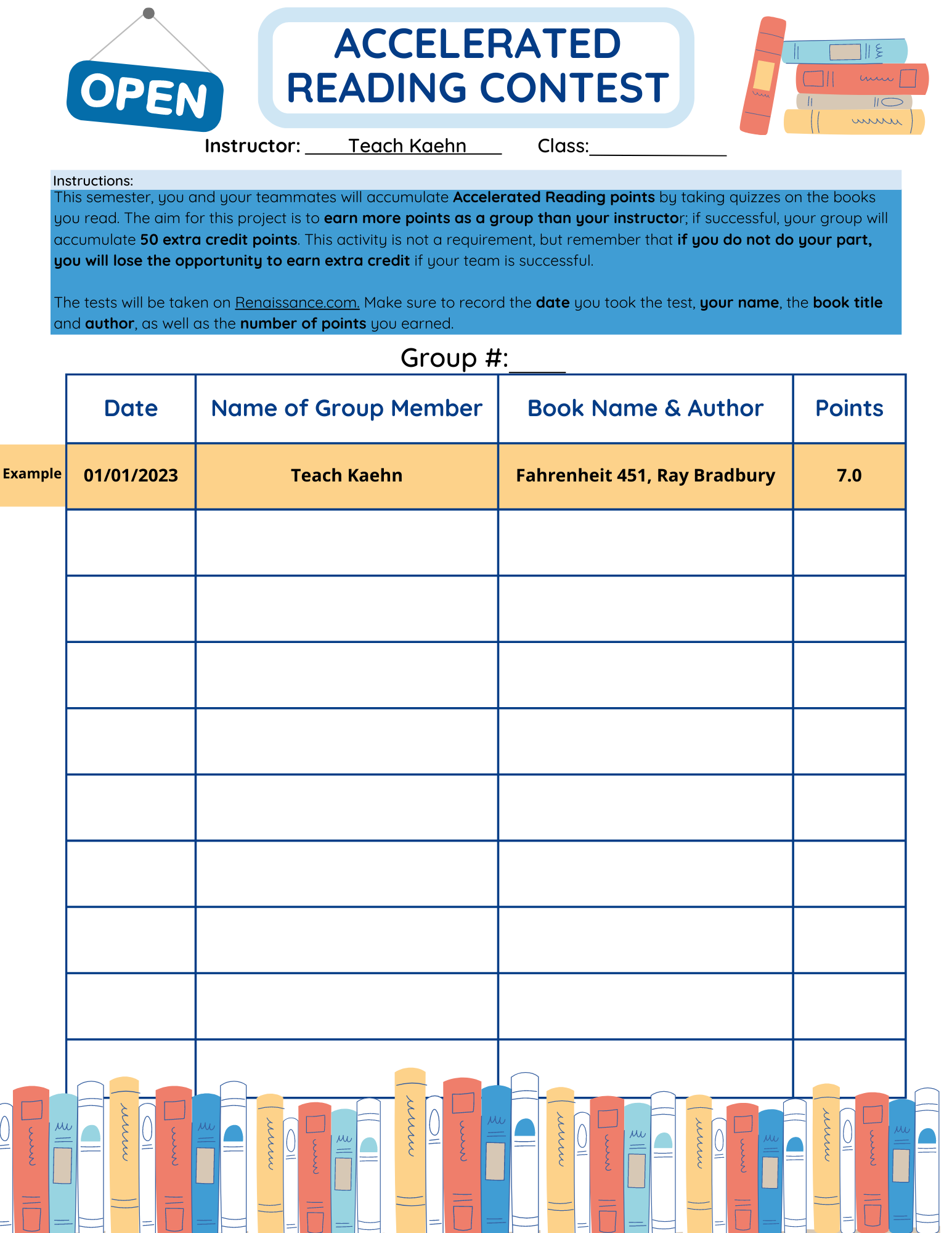
Artifact 2 is a group project/activity that requires high teacher dominance and high student cooperation (Marzano et al., 2003). This project is a contest between several groups within the class and me. I will have to read several books and accumulate points through the Renaissance.com AR tests, as will my students. Come the end of the semester, if any groups can earn more points than I do, they will receive 50 points of extra credit (per student). This is a great way to elicit strong morale and enthusiasm to do something that many high school students struggle with (reading). The competitive nature of this activity makes for an exciting and high-stakes project and brings students together in their effort to surpass me. Though the assignment is not for an actual grade, instead—extra credit, I will have to monitor my students and ensure clear and steadfast guidelines so that they are more willing to move forward and rely on one another rather than their competition (Marzano et al., 2003). To correctly complete the worksheet, group members must fill out their test date, their name, the book title and author, and how many points they earned. This way, I can track who contributed and whether everyone in the group tried to obtain points for their team. Students will not be punished for their resistance to do the extra credit, but if their team wins and they did not help, they will not receive the 50 points.
Artifact 3:
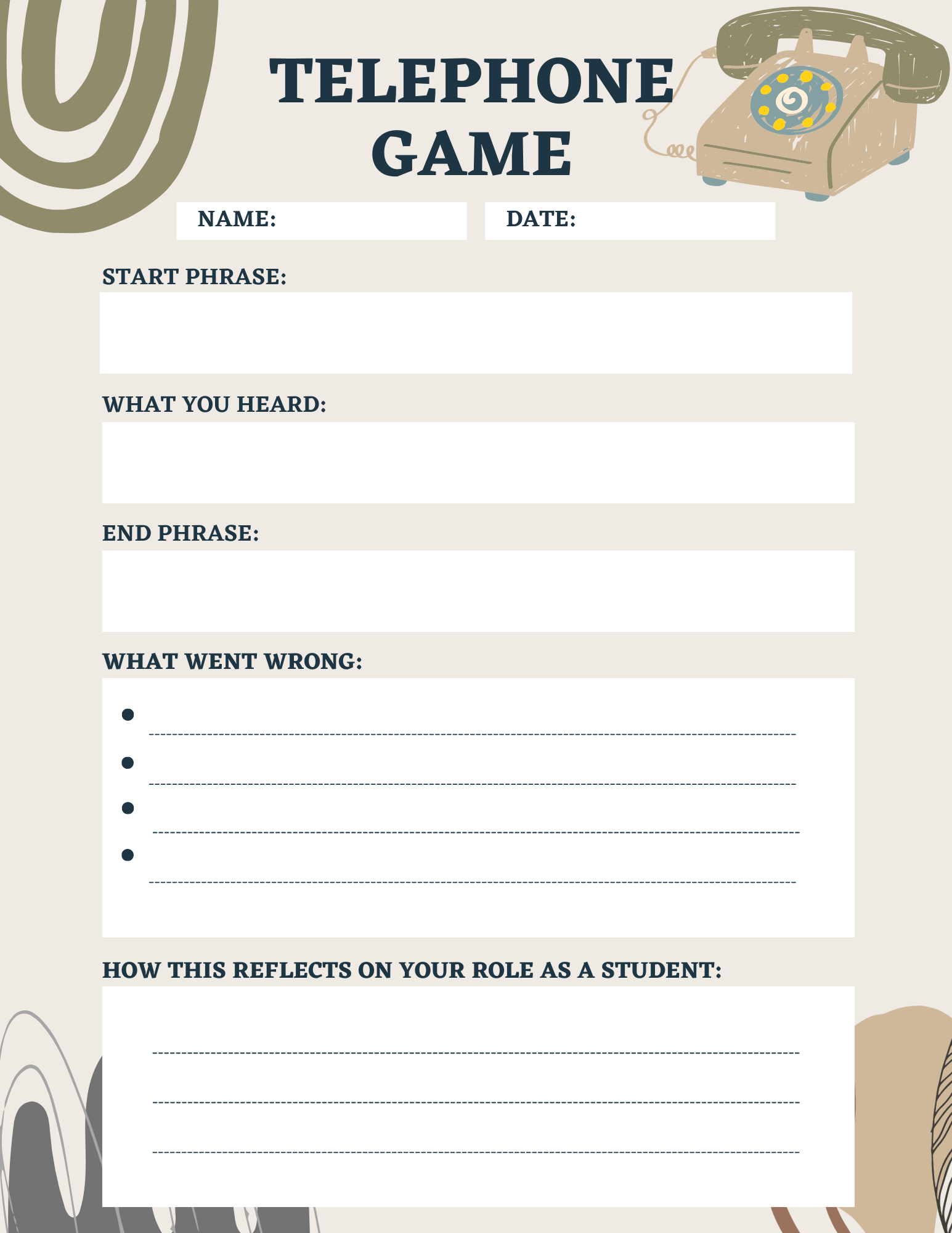
Artifact 3 is the activity of the telephone game. This game can be completed multiple times throughout a semester to accurately make students aware of their role in the classroom and adjust accordingly (Milner et al., 2018). I will first give the phrase to a student in my class, who will then turn to their peer and whisper what they heard in the next person’s ear. After a student has been told the phrase and they have repeated what they listened to their partner, they should write what they heard in the “What You Heard” box. I will ask that my students pay close attention to the mannerisms and attitudes of their classmates as the game continues. Once the phrase reaches the last student, they will call out what they heard, and everyone will write this in the “End Phrase” box. After the final phrase is revealed, I will share the initial sentence. Since the students should have been paying attention throughout the game, they should be able to share where in the line of students they believe the phrase to have gone askew (they should do this without naming names, instead, beginning, middle, end). In this reflection, students should also consider how they could have improved their listening skills during the game. Finally, students should process and answer how their interpretation of the phrase shows their role as a student (this could be in broad or general terms). I think this is a great exercise to have students complete so that they can step into the shoes of an instructor, as they will now have to dissect events, piece together information, and consider how their actions affected their environment (Marzano et al., 2003)
References
Himmele, P., & Himmele, W. (2017). Total participation techniques: Making every student an active learner. Association for Supervision & Curriculum Development.
Marzano, J. S., Marzano, R. J., & Pickering, D. J. (2003). Classroom management that works: Research-based strategies for every teacher. ASCD.
Milner, H. R. I., Cunningham, H. B., & Kestenberg, E. G. (2018). These kids are out of control: Why we must reimagine classroom management for equity. Corwin Press.
Venet, A. (2021). Setting Priorities in Trauma-Informed Education. Edutopia. https://www.edutopia.org/article/setting-priorities-trauma-informed-education