Classroom Management Stance: How I Can Maintain Respect and Authority Within my Class
A large part of being an instructor that is rarely considered is the amount of time and dedication that goes into planning all aspects of a classroom. Most individuals see teaching as purely academic, adding no more or less to students’ personal lives, but as those who must undergo the journey to becoming a teacher know—they do. Teachers must prepare for every aspect of the classroom; thought and consideration are required, and instructors must be equipped to handle any issue emotionally, physically, verbally, and mentally. Providing the structure of a well-managed classroom requires hard work, which is why utilizing outside resources can become a teacher’s best gamble. Providing student autonomy and clear expectations, methods to showcase structure, and clear feedback and communication is the key to establishing the rules, consequences, and procedures that every classroom must have.
A successful classroom must be student-centered. Though this does not mean student-led, I desire to make students feel seen and heard by their instructor. This kind of instruction helps to open them up to new ways of teaching, ideas, and classroom participation (Himmele & Himmele, 2017). Student-centered instruction requires student input and feedback; therefore, I will allow students to aid in the construction of classroom rules. Students will manufacture rules for themselves and their peers to follow, as well as a set of reasonable rules for me. Once again, this is not to give students all the power but rather a unique way to practice instructor self-reflection and see how past experiences in the classroom have impacted students (Milner et al., 2019). I want to establish a respectful atmosphere between the students and me by maintaining firm but reasonable expectations and equitable disciplinary responses.
Not every action that takes place in a school setting requires a reaction. When a child wears a hood in class, doodles on a piece of paper, or chews a piece of gum—sure, they are breaking the rules, but to what extent do these violations harm anyone? In many cases, students who wear a hat or a hood in a class cover up their hair, block out strenuous stimuli or are just cold. Doodling on a piece of paper during class may help a student focus or—better yet- signal to me that my lesson makes them feel disconnected. If the students are disengaged, I should find a different way to present and not get mad at them for not being engaged (Himmele & Himmele, 2017). Chewing a piece of gum is one of the most harmless actions a student can perform, and I do not have a problem with the action as long as the gum is appropriately discarded. Actions that are more relevant to me are harmful ones towards myself and other students or directly violate the rules and policies agreed upon at the beginning of the school year. When a student disobeys the class rules, they do not just disrespect my authority but the entire class. I feel it is important for the entire class to be able to see their progress with respect in the classroom and see their improvement (Milner et al., 2019). My documentation would most likely be secluded to my computer, with vague postings and announcements about how the class is doing on the walls or front board.
Students and parents should be able to readily and easily access information regarding student progress throughout the semester. In my experience as a student, it was very easy to hide my grades as my family did not have easy access to a computer growing up, and my mom did not have a smartphone. My parents only saw my grades or received any news about me (good or bad) through my midterm and final grades. Though access has only become more widespread over the years, kids will forever be sneaky; therefore, I would want some form of mediated communication between myself and their parents (preferably through my school email and a professional email of the parents). This also prevents my feedback from being too vague in rushed and mandated progress reports; I can take time to tell guardians how students are doing in my class—in depth (Marzano et al., 2003).
Providing student autonomy and clear expectations, methods to showcase structure, and clear feedback and communication is the key to establishing the rules, consequences, and procedures every classroom must have. Student-centered classrooms showcase the importance of expectations and balance between flexibility and rigidity (Marzano et al., 2003). Discipline is only fair if contexts, backgrounds, and individual understandings are considered. Finally, communication is important for all participants involved in a student’s learning journey. I and other teachers cannot rely solely on pupils to accurately and dutifully relay their progress.
Artifact 1:
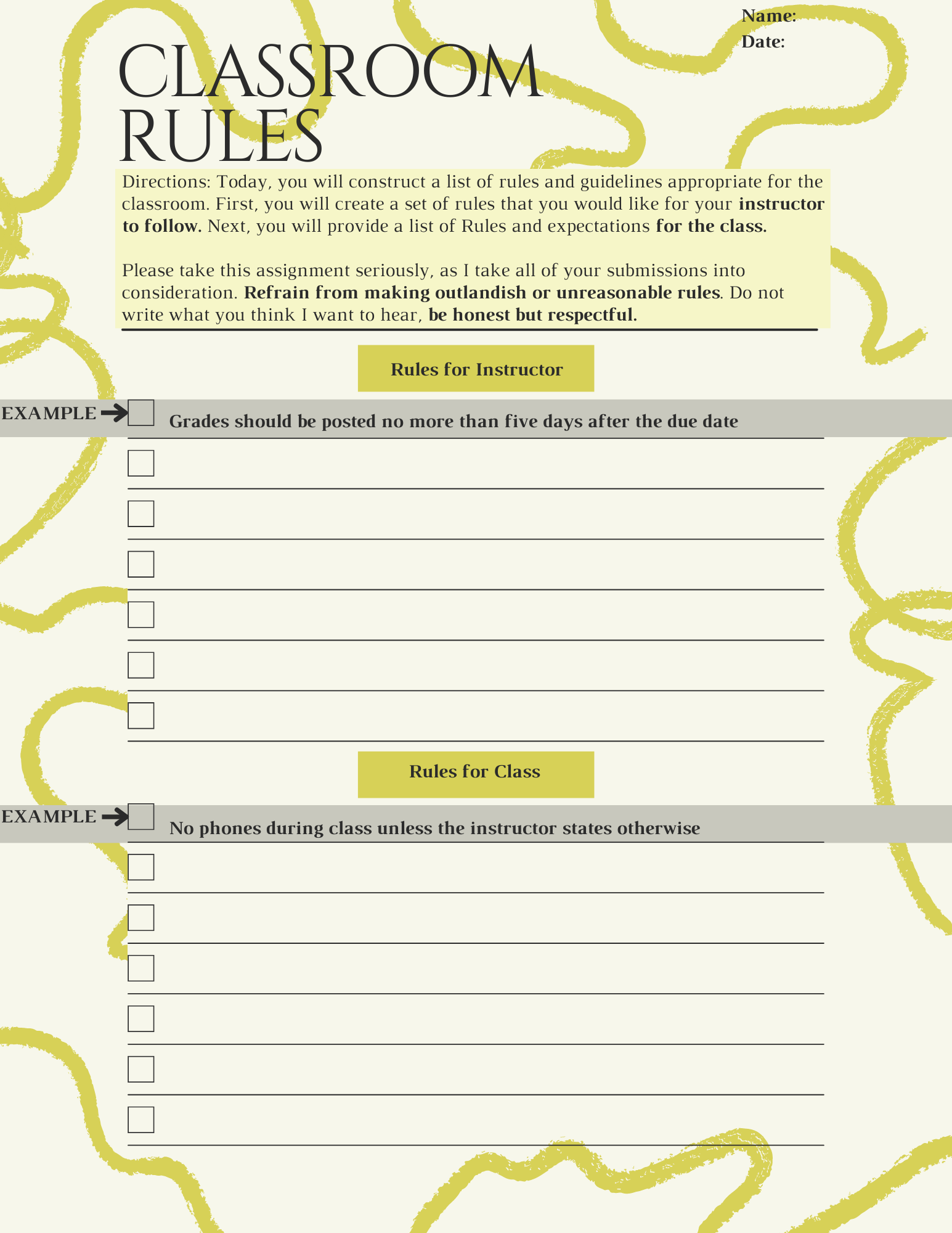
Artifact 1 is a worksheet regarding classroom rules. The students will be permitted to take this assignment home to ponder, think through, and fill out the sheet to the best of their ability. First, I will go over the assignment, talking through the directions as well as my reasonings for the examples. The first example under “Rules for Instructor” comes from my experience as a student. Nothing irks or enrages me more than when I submit an assignment on time and my professor does not grade what I have submitted in a reasonable amount of time. As for the second rule—through my observations in the classroom, I have found that students being on phones during class is a big issue. This issue can be solved through simple respect and understanding; thus, the class should not be on their phone during my class unless stated otherwise. These examples draw from my experiences in life and bring my background and understanding to light (Milner et al., 2019). After I have presented the assignment and read through the instructions/examples, the students will manufacture a set of rules for themselves and me. After the students fill out the rules (remaining respectful and reasonable), they will turn in the paper, and I will go through them, checking off which rules I like/see the most in order to construct a reasonable, well-thought, and fair set of rules for the class.
Artifact 2:
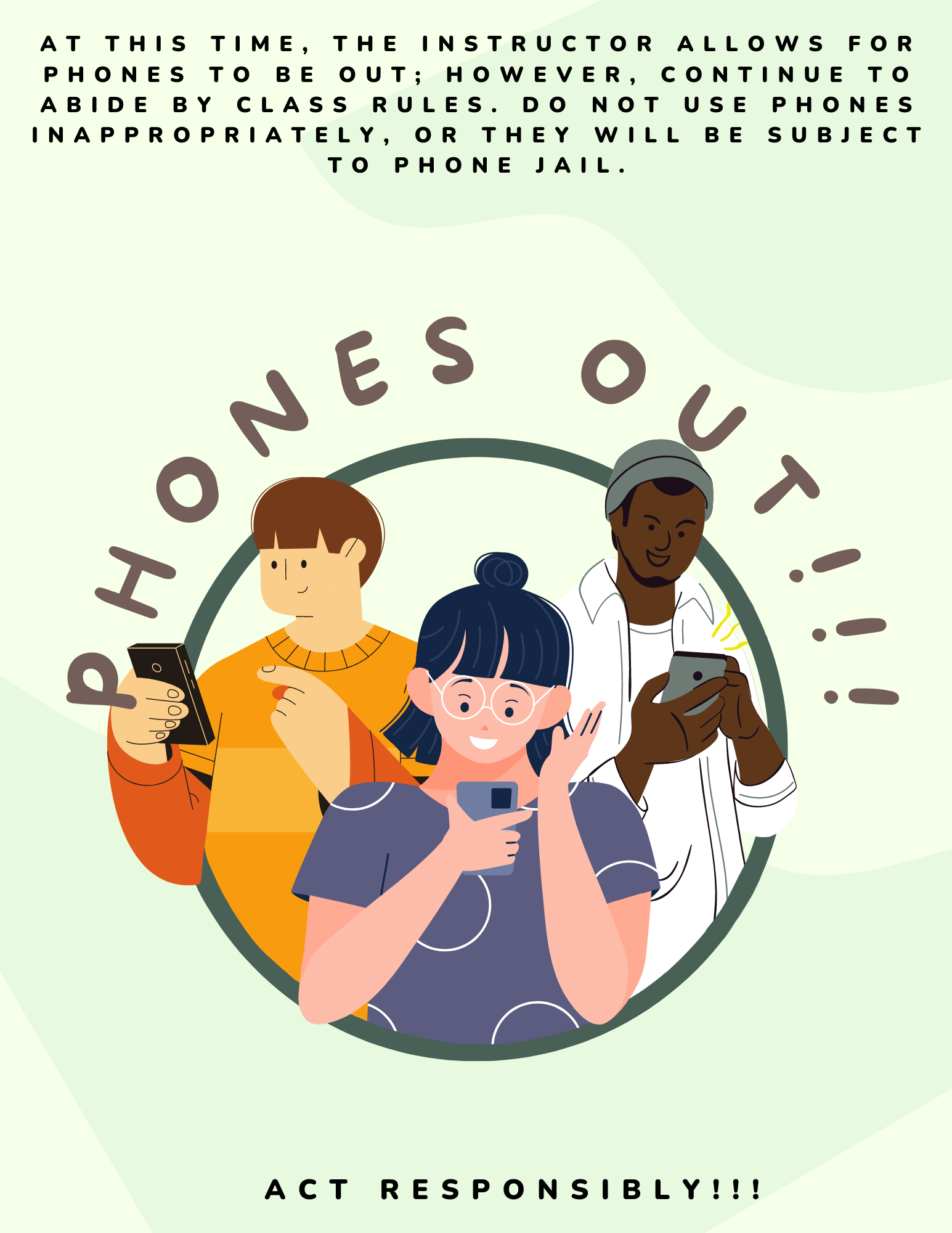
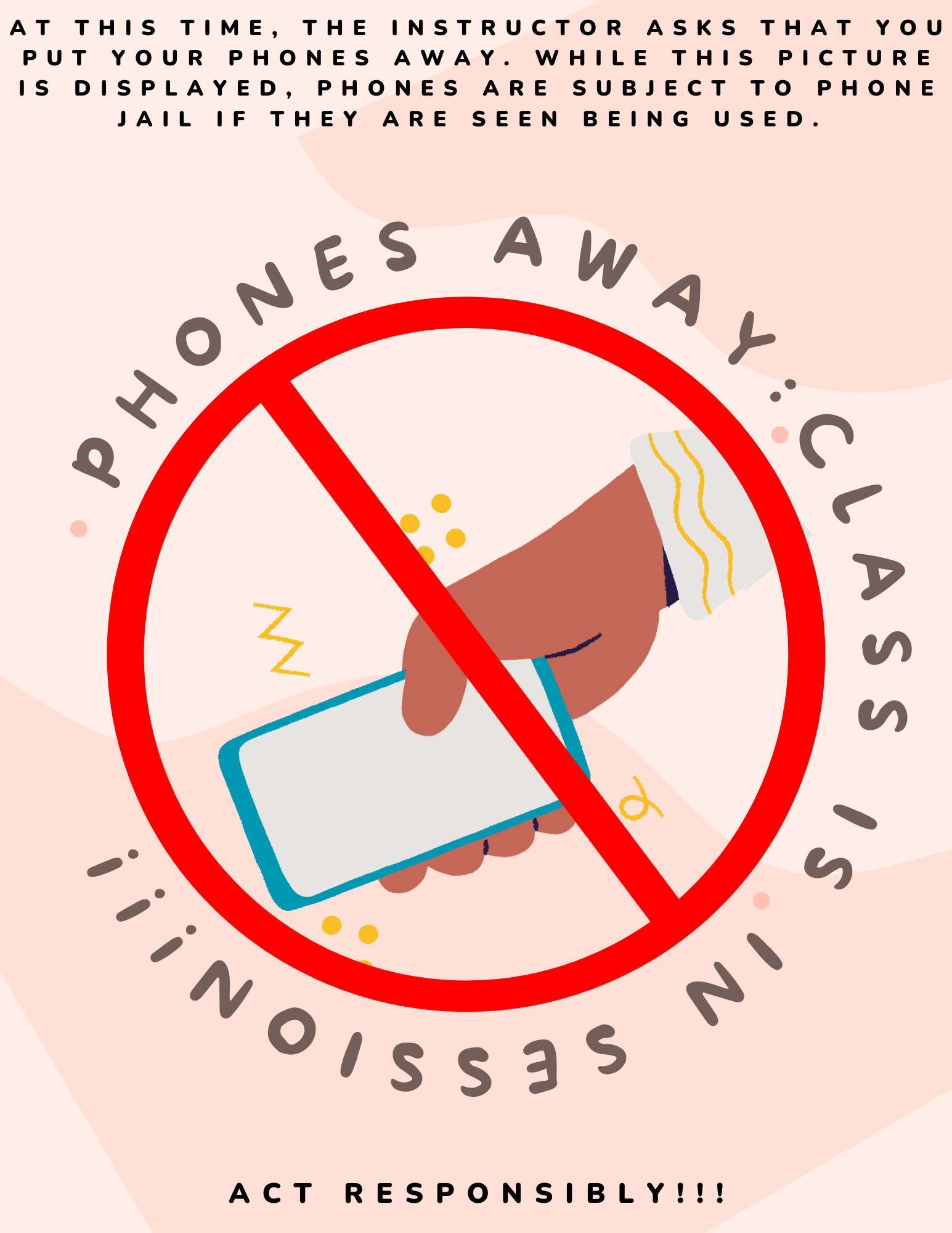
Artifact 2 is a front and back laminated poster that quickly and efficiently reminds students of a critical rule in my classroom. One side of the poster reads “Phones Out,” while the other says “Phones Away: Class is in Session.” This artifact is straightforward in my expectations, and little room is left to debate the interpretation of this display; however, I provided written and in-depth clarification as to what the words and images below indicate. This prevents misinterpretations and voids any excuses a student might make if they choose to break a rule (Milner et al., 2019).
Artifact 3:
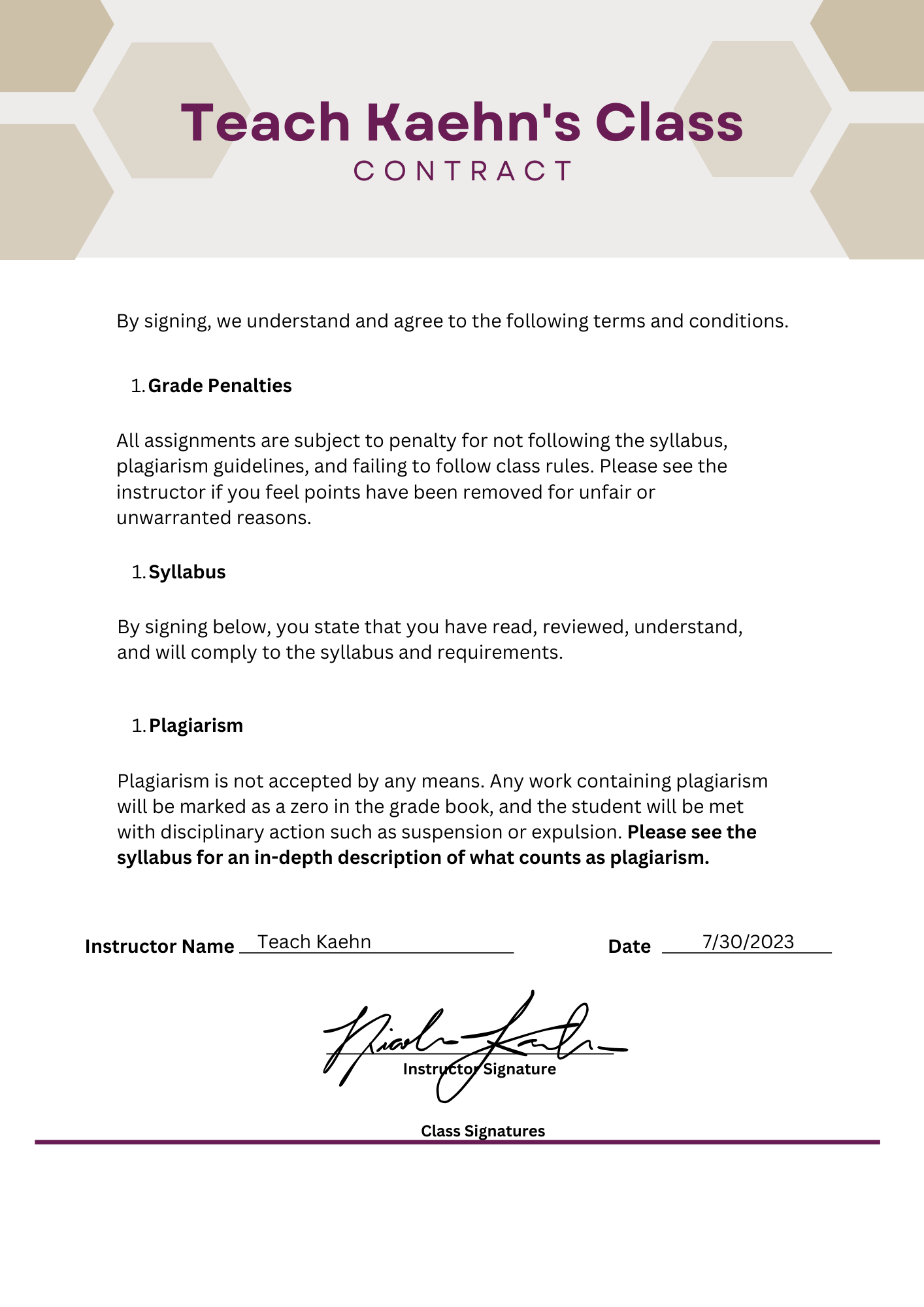
Artifact 3 can stand alone or coincide with Artifact 1 as it pertains directly to class rules. This stands alone through presentation and the fact that the students do not necessarily have to help construct the rules to sign the contract. This artifact is an agreement or “contract” between the students and me. Three important aspects of the class rules are stated in full display, while the others are referenced to be in the syllabus. I chose to include this kind of visual in the classroom to remind students that they agreed to my terms and conditions at the beginning of the school year. Students need a reminder, and sometimes I will need one as well. Say I grade a student’s paper late—though I will not face the same consequences that a student might for breaking the rule, it is essential that I abide by the class rules to give the respect I wish to see from my students (Milner et al., 2019).
Artifact 4:
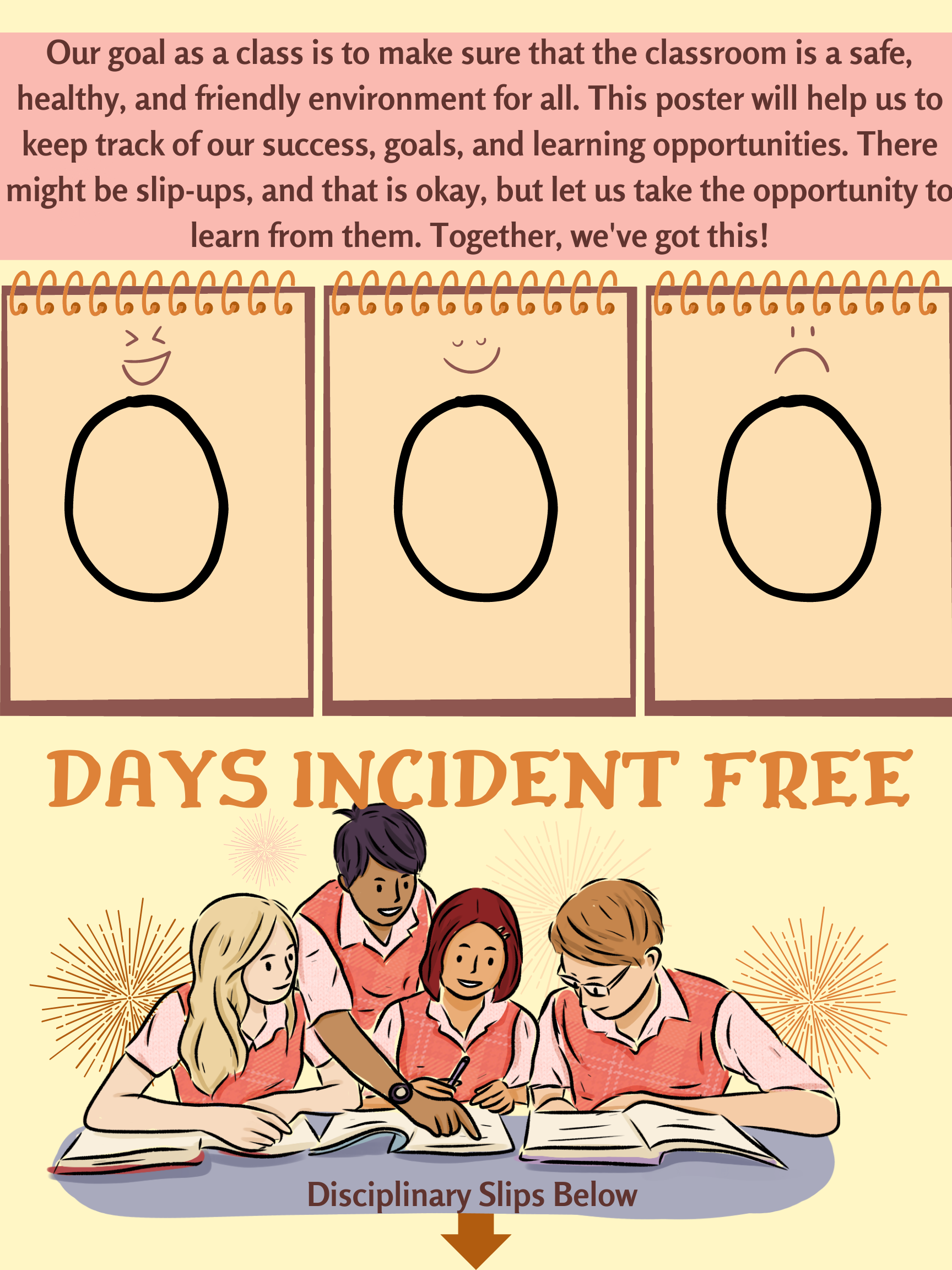
Though I am pleased with every artifact I have constructed for this class, I am particularly enthusiastic about artifact 4. Initially, this idea started as a joke as many workplaces showcase signs showing the number of days since a workplace accident or injury. The more I thought about it, the more I realized how constructive a display like this would be for discipline and classroom management. This laminated sheet works by me writing with dry-erase markers how many days have gone by without an incident. Incidents can be as small as gum left under a desk or as big as a student harming another student. The beauty of the board is that it is a helpful way to keep track of how a class is doing without handing out unwarranted or overresponsive punishments (Milner et al., 2019). Detention slips, ISS forms, and other forms of documentation will be kept below the poster on a desk or in a basket, but only some incidents will require such documents. Instead, the issue can be called out, talked about, and moved on from in peace—diffusing a situation before it truly starts. I also enjoy the idea of students looking to see whether the board has been updated every time they come to my class, pushing engagement surrounding aspects outside of academics (Himmele & Himmele, 2017), and holding everyone accountable (Milner et al., 2019).
Artifact 5:
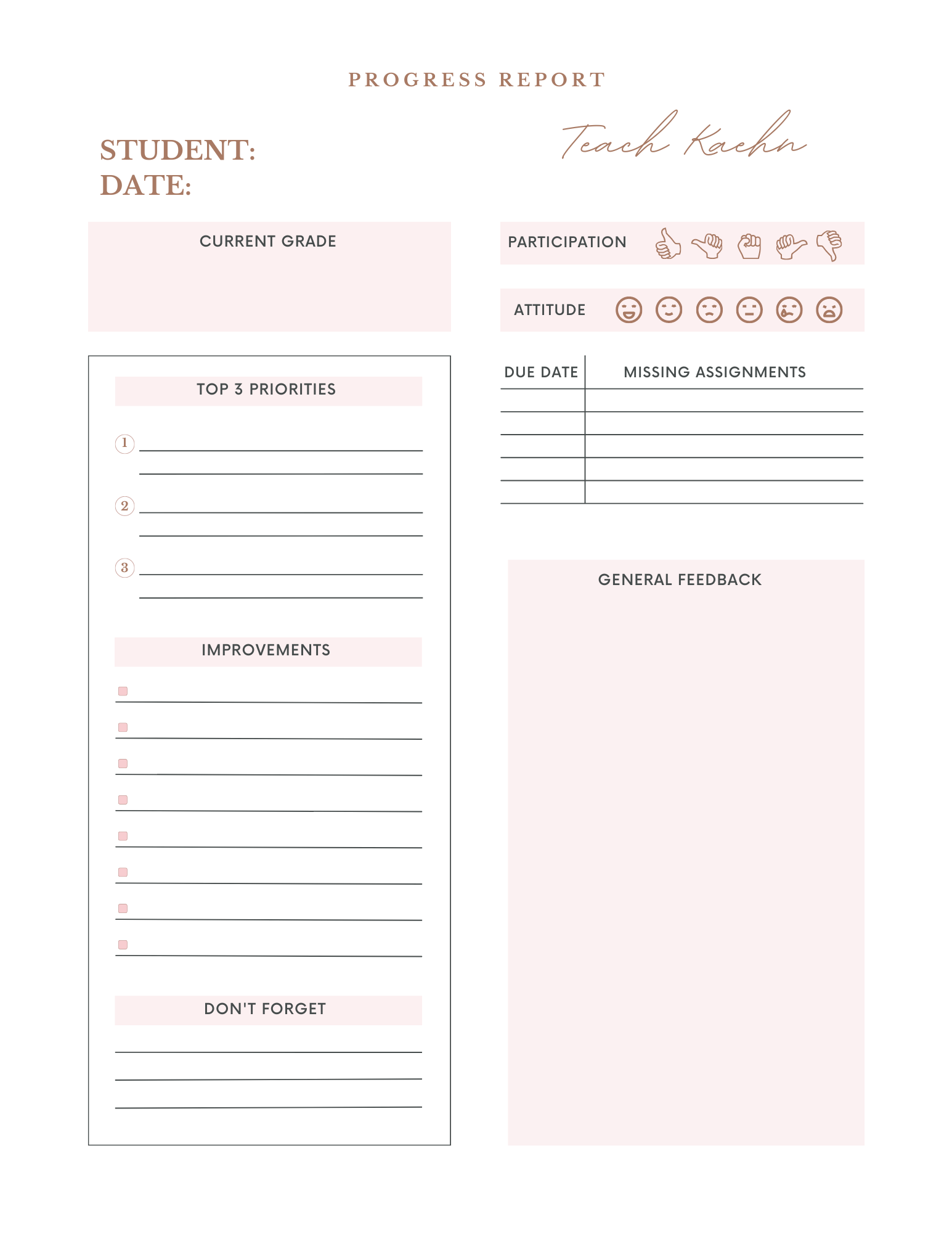
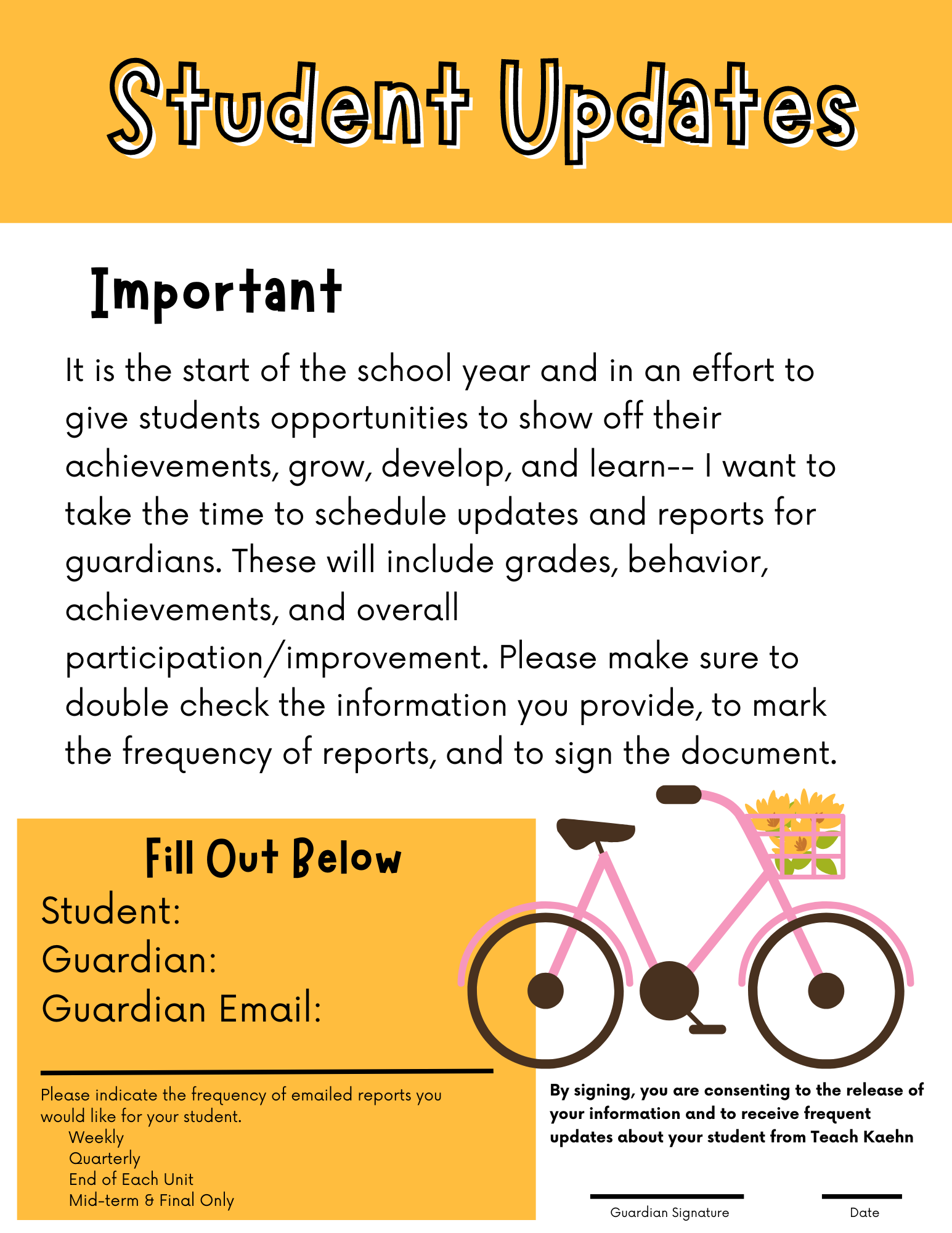
Many experienced teachers would take one look at Artifact 5 and laugh out loud. The amount of work going into this kind of communication would seem ridiculous to many. Though I know that consistent student updates would be challenging to maintain, it is one of the best ways to ensure that what is being taught and expected in the classroom is maintained and reinforced outside of school. Students will be expected at the beginning of the semester to take home the Student Updates newsletter and have their guardians fill out the information at the bottom. This will be worth a grade as an incentive to be sure that students have their guardians fill the paper out promptly. Guardians will write their student’s name, their full name, and email. After providing their email, they should indicate how frequently they would like to be updated on the pupil’s progress. Signing at the bottom of the page gives me consent to contact them. The second part of the artifact is a paper copy of what I would fill out with each update. First, I would provide the student’s name, the date of the report, and the student’s current grade as posted. Next, I would provide what I am focused on working with the student on. This could be strengthening a skill, building a new one, or correcting behaviors. Improvements would be listed underneath, small or large. Reminders for students and parents will be noted (important dates, things to work on at home, my office hours, etc.). I will then indicate how well a student is doing with their participation and attitude, as well as any assignments they may be missing. This provides parents with further insight into why a student has a particular grade without me breaking down the entire grade book and assignment scores. Finally, I will add any additional thoughts or feedback that I feel is necessary to provide parents with. Most parents will not want a constant stream of updates regarding their child, especially if they are earning good grades in my class, but this provides an opportunity for guardians to take on a more active role in a child’s education journey and see not only where a student is struggling, but where they are improving and excelling. Sometimes, students are given too much responsibility—even at a high school level.
References
Himmele, P., & Himmele, W. (2017). Total participation techniques: Making every student an active learner. Association for Supervision & Curriculum Development.
Marzano, J. S., Marzano, R. J., & Pickering, D. J. (2003). Classroom management that works: Research-based strategies for every teacher. ASCD.
Milner, H. R. I., Cunningham, H. B., & Kestenberg, E. G. (2018). These kids are out of control: Why we must reimagine classroom management for equity. Corwin Press.