
The AI Era has completely disrupted the traditional rules of Enterprise API Management. For the last decade, API strategy focused heavily on human-driven consumption—developers reading static documentation and applications making predictable, deterministic GET and POST calls.
Today, the landscape looks radically different. Driven by the mass adoption of AI Agents, Large Language Models (LLMs), and protocols like the Model Context Protocol (MCP), Gartner reports that over 30% of new API traffic demand comes directly from AI systems. By the end of this year, up to 40% of enterprise applications are projected to feature autonomous, task-specific AI agents.
Because AI agents make non-deterministic decisions, chain unforeseen API calls together, and consume resources at unprecedented speeds, traditional gateways are no longer enough. The best enterprise API strategy has shifted from a Connectivity Layer to an AI Control Plane.
The Four Pillars of an AI-Era API Strategy
To govern an enterprise where AI agents are your primary consumers, your API strategy must adapt across four critical domains.
1. From Restricting Traffic to “Token-Aware” Rate Limiting
Traditional API management throttles traffic by requests per minute (RPM). For an LLM or AI agent, this metric is useless. A single request containing a massive context window can cost an organization fifty times more compute and money than a simple short query.
- The Strategy: Implement gateways capable of parsing token consumption and payload size in real time. Your control plane must enforce quotas based on financial limits and semantic caching (storing previous AI responses to avoid paying to hit the LLM multiple times for the same question).
2. Adopting AI Gateways as a Security Buffer
Exposing raw, unshielded internal APIs directly to AI agents introduces massive vulnerabilities, including Server-Side Request Forgery (SSRF) and Prompt Injection. If an agent interprets a malicious prompt, it can be tricked into executing unintended API deletions or data extractions.
- The Strategy: Deploy dedicated AI Gateway capabilities (found in modern enterprise stacks like Azure API Management, Kong, or Tyk). These gateways provide “Model Armor,” evaluating incoming prompts and tool-execution parameters for safety, content filtering, and data masking before the downstream systems can execute them.
3. Solving the Agent Identity Crisis (Runtime Authorization)
When an automated AI agent calls an API on behalf of an executive, what are its permissions? Traditional APIs authorize static machine-to-machine traffic via Client IDs or API Keys. This fails in an agent economy where an agent acts dynamically with delegated human authority.
- The Strategy: Shift from static, gateway-level authentication to dynamic, runtime, identity-aware authorization. Every API target must validate the underlying context: Who is the user initiating this agent workflow, and does this specific agent have the temporary right to alter this data right now?
4. Standardizing Integration via MCP and Unified APIs
As enterprises adopt a multi-model world—simultaneously using OpenAI, Anthropic, private local models, and specialized vector databases—developers face massive fragmentation when writing custom integrations for each tool.
- The Strategy: Standardize your internal catalog using the Model Context Protocol (MCP) and Unified Model APIs. By exposing your corporate systems as standardized MCP tools, any compliant AI agent can automatically discover and safely interact with your databases, eliminating the need to build custom connectors for every new AI application.
To implement this strategy cleanly without overwhelming your DevOps teams, transition your API ecosystem toward this architectural pattern:
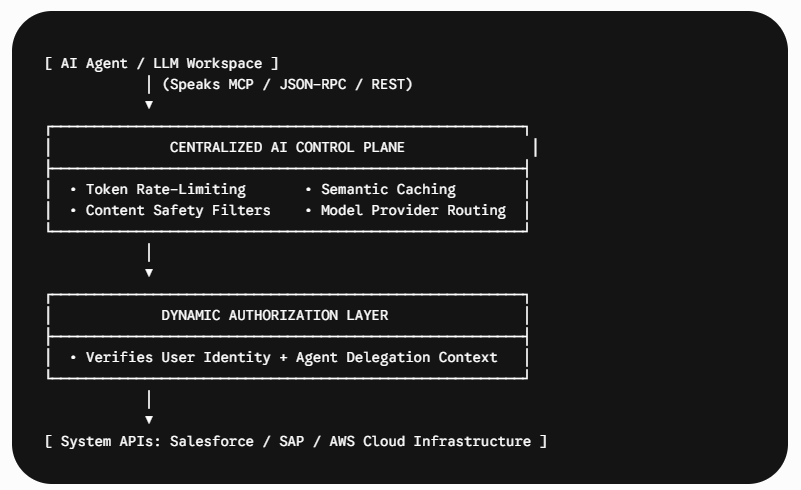
Executing the Transition
If you are upgrading an existing enterprise architecture, prioritize your rollout in three progressive steps:
1.Establish Financial and Egress Guardrails:Immediate Priority.
Route all outgoing LLM and third-party AI requests through a central gateway. Turn on token tracking and semantic caching to instantly stop budget overruns and prevent employees from inadvertently leaking proprietary source code or PII to external models.
2.Unify Your Model Abstraction:Next 60 Days.
Deploy a Unified Model API layer. This shields your developers from specific vendor SDKs, allowing your infrastructure team to dynamically reroute AI traffic or switch your default primary model provider behind the scenes without breaking your production codebases.
3.Expose Legacy Core Systems Safely:Strategic Goal.
Package your internal data integrations (like your MuleSoft flows, AWS Lambda microservices, or databases) as securely managed API products wrapped in standard agent protocols. This officially transitions your business into a plug-and-play platform ready for the agentic economy.
The Bottom Line: In the AI era, API management is no longer just a technical developer tool; it has evolved into a vital business risk, compliance, and cost-control function. The organizations that win will be the ones that stop treating AI as an isolated add-on and start governing AI agents as their most active, high-velocity class of users
Leave a Reply