V-TOP Micro-Internship – Summer 2026
Introduction & Career Focus
My name is Joana Camp, and I’m a BS OTS Training Specialist major with minors in Psychology and English (Technical Writing). My work sits at the intersection of sociotechnical systems, workflow design, and public‑sector modernization. I’m especially drawn to understanding how people experience complex systems — and what happens when those systems become fragmented, confusing, or hard to navigate.
A lot of my academic and professional energy goes toward reducing administrative burden, improving coordination across services, and designing workflows that help institutions build trust with the communities they serve. Long-term, I hope to contribute to more human‑centered approaches to housing, education, and public service systems.
Post‑Graduation Goals
After graduating from ODU, I plan to pursue a PhD in Human‑Centered Design & Engineering, focusing on sociotechnical systems, implementation design, and public‑sector innovation. I’m interested in building tools, workflows, and communication systems that make critical services more accessible, coordinated, and sustainable.
Internship Overview
Virginia Micro-Internship – TLC NextGen Consulting
In June 2026, I completed a competitive Virginia Micro‑Internship sponsored by the Virginia Talent + Opportunity Partnership (V‑TOP) and administered through Parker Dewey. I served as a Knowledge Management Consultant for TLC NextGen Consulting, a SWaM‑certified firm specializing in organizational readiness, capability development, and strategic transformation for public‑sector agencies and mission‑driven organizations.
This wasn’t a hypothetical assignment. I was brought in to audit a real corporate knowledge base and rebuild it into a unified, scalable system. My primary responsibility was to transform a fragmented collection of documents into a structured, searchable taxonomy the firm could use immediately.
Key Contributions
Resource Audit — Cataloged 60+ corporate assets, including consulting methodologies, sales proposals, contract templates, and internal operational files.
Taxonomy Design — Built a 7‑tier classification system that organized materials across core functions: Sales, Client Delivery, Legal, Marketing, Training, Operations, and Technical Systems.
Technical Interface Inventory — Expanded the project scope by auditing 40+ Work Asset Management (WAM) and Mobile Work Management (MWM) system integrations.
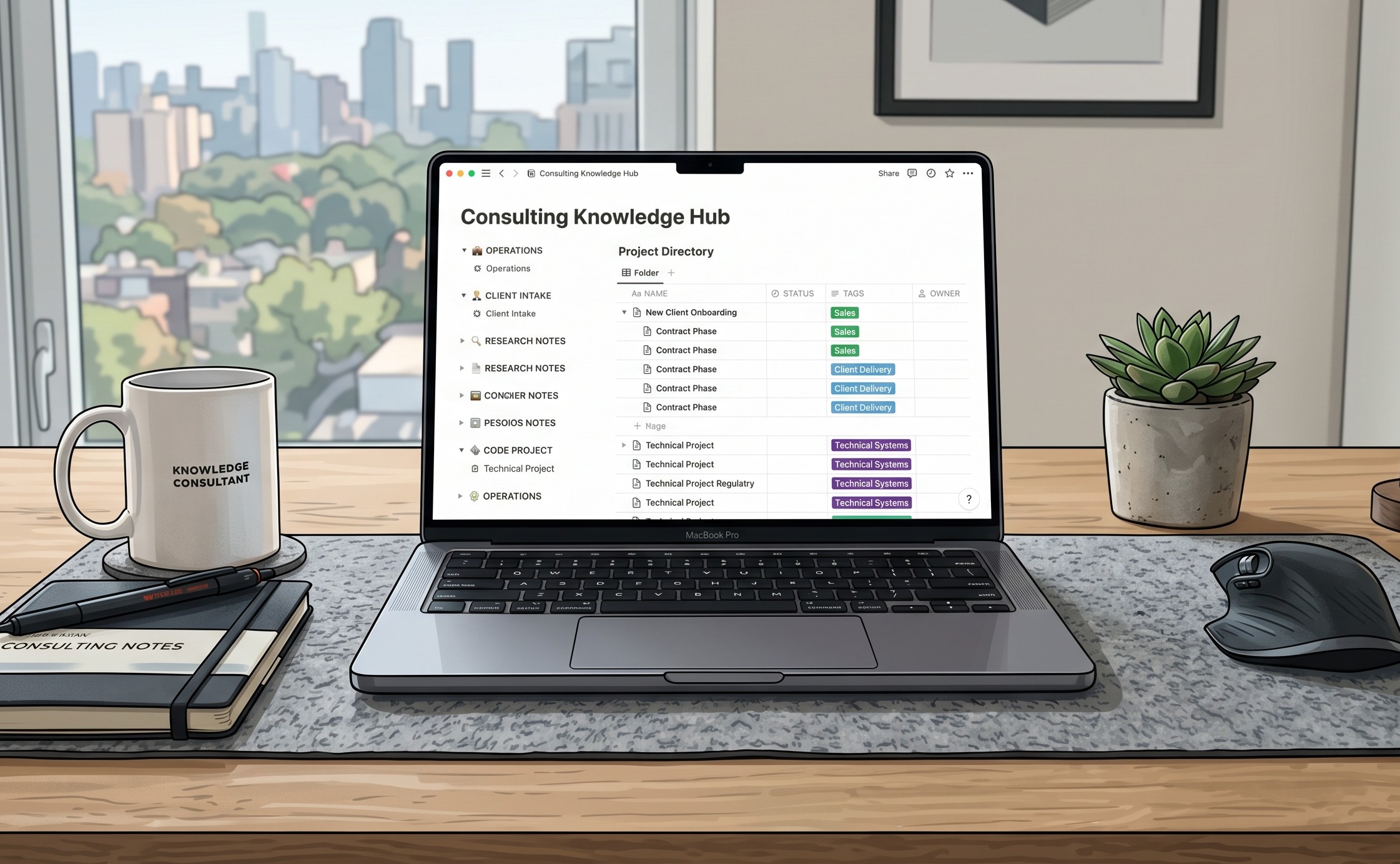
Knowledge Base Architecture — Designed a four‑layer framework using Google Drive for storage and Notion as the centralized navigation and search dashboard.
Gap Analysis & Strategic Roadmap — Identified recurring operational vulnerabilities and authored a three‑horizon strategic plan (0–90 days, 3–12 months, 12+ months) to guide long‑term scalability.
Reflection on My Experience
Where the System Was Breaking Down
One of the biggest challenges was the firm’s information retrieval friction. They had strong intellectual capital — but it was scattered across tools, folders, and naming conventions. That fragmentation created a “bandwidth tax” on team members who needed to locate assets quickly.
My goal was to reduce cognitive load and make the system feel intuitive. By building a logical taxonomy and a clean Notion interface, I focused on making critical workflows and technical maps instantly accessible.
Navigating Real‑World Constraints
This internship demanded adaptability from day one. Several unexpected issues shaped the project:
- The main Notion workspace had severe access failures that never got resolved.
- All three scheduled check‑ins fell through due to competing schedules, leaving a five‑week gap with no structured feedback loop.
- No premium AI tools were provided, despite the project requiring advanced file curation.
To stay within the strict 15-hour limit, I built a workaround by chaining together free, public AI tools to clean, categorize, and serialize the data. Balancing this project with my personal life and the start of a demanding summer internship required strict organization and sharp time management.
Processing Professional Critique
The project concluded with a detailed, professional-level review from the Project Manager. I earned an A‑ on the taxonomy framework (D2), which they described as “genuine professional‑level structural thinking” and “immediately usable.” My overall grade was B‑, and the critique on the remaining layers was incredibly valuable.
Two lessons stood out:
- Verbal clarity isn’t enough. If a design rule is explained verbally, it must also be documented explicitly so the system can stand on its own.
- Proactive escalation is essential. When tools fail or communication stalls, it’s critical to flag the issue immediately through alternative channels to protect project hours.
These insights will stay with me. They reinforced that my systems training holds up under messy, real‑world conditions — and that I’m at my best when navigating structural chaos and turning complexity into clarity.
Resume
Official Completion Record