
Explain how the principles of science relate to cybersecurity.
Cybersecurity is an applied science. People within the field use theories, laws, and scientific information to create powerful computing systems that can be used in today’s world.
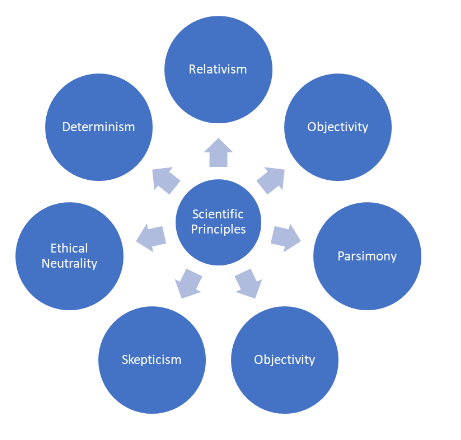
Above is an image demonstrating the scientific principles. Which, argued in the 1970s by a Mr. Bierstedt, reveals that social sciences can be applied to the same principles as natural science. These principles, when looked through the lenses of a social science framework, can easily be applied to cybersecurity.
Relativism
Relativism refers to how all objects are related. In the context of cybersecurity, an example could be that changes to one system will result in changes to another. Within real world scenarios, we must fully recognize that the technological changes present to systems and devices will have a real world influence on the surrounding region from policy making to behavioral differences.
Objectivity
Objectivity refers to how scientists student topics in a value-free manner. The world of science is filled with fact, there is little room to promote opinion. As an individual studies cybersecurity, they must approach topics and research with the same objectivity. There will come a time when we must ask ourselves difficult questions concerning ethics and opinion, but we must look through it with clear, subjectivity-free lens.
Parsimony
Parsimony refers to the way scientists should keep their explanations simple and understanding. Within the field of cybersecurity, this is a bit more difficult. While most questions can be answered easily, questions related to human behavior are more complex. A humans behavior has multiple reasonings and multiple factors depending on how they live and where they grew up (only two of the hundreds of possibilities).
With personality and behavioral theories, though, we can summarize the answers. A great example is the Self-Control Theory or the Routine Activities Theory. These theory pose an answer to why crimes are committed and are recognized by millions. The theories are simple and provide a more simplified answer to a complex question. This shows how strong the bond is between social science theories and the principles of parsimony within cybersecurity.
Empiricism
Empiricism refers to how social scientists can only study behavior that is real to the five senses. It explains how scientific knowledge is from what we experience and agrees that our knowledge must come from empirical research, or what is real to us. In the context of cyber security we shouldn’t rely on opinions to frame our understanding. In order to have conclusions, it must be objective and real.
Ethical Neutrality
Ethic neutrality refers to how scientists must adhere to ethical standards when conducting research. We must protect our human rights and rights of the individual when studying, further proving that we are willing to study topics empirically and objectivity. Cybersecurity offers opportunities to explore the ethical issues presented in the field, such as the privacy (or lack thereof) for an individual on the internet. Additionally, just how easily it is to leak crucial information for millions to see.
Within the field of cybersecurity, we must do our best to adhere to these standards just as well as any other scientist promises to do. Being on the internet does not offer an open pass to violate these constitutional and human rights.
Determinism
Determinism refers to the behavior that is caused, determined, and influenced by preceding events. Much like parsimony, this principle is harder to apply to cybersecurity than natural science. The human brain is much more complex and confusing. In fact, many believe that human behavior is not determined or influenced by past events, and that behavior is of free-will. Many believe that individuals should be held accountable for their behavior, which is why they oppose determinism. But determinism fully believes that individuals, despite their situation, should be held accountable.
Models of Determinism:
Nomothetic model – identifies the relatively few causes of a behavior (e.g., a cyber incident)
Idiographic model – identifies the multiple causes over time of a behavior (e.g., a cyber incident)
In the field of cybersecurity, Determinism can be used to answer a handful of questions from why someone commits crime to why an individual was vulnerable to a crime. By finding the answer, those within the field can better understand how to avoid those crimes and vulnerabilities in the future.
Each principles has it’s own relationship to cybersecurity. All can be applied equally and all are crucial to the cyber space. Cybersecurity is as much as a science as it is anything else.